Lee Legislation Aims to Provide Critical Support to Nevada Students
Watch and Download Video of Press Conference
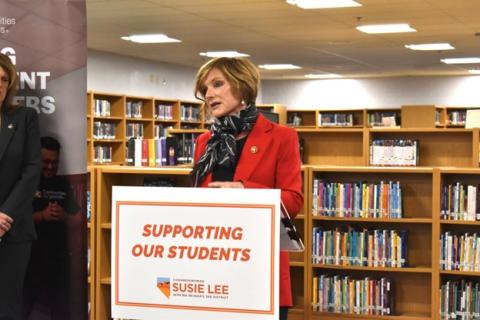
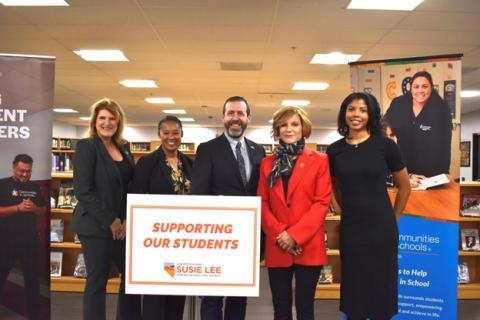
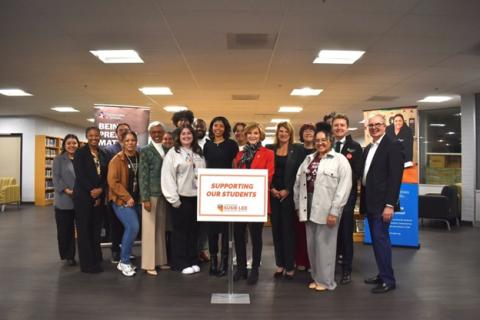
LAS VEGAS, NV – Today, Congresswoman Susie Lee (NV-03) joined Ed W. Clark High School principal and a recent graduate, Clark County School District, and Communities In Schools of Nevada to highlight her Full-Service Community School Expansion Act, which improves student outcomes by helping public schools and districts bring in wraparound support services. These include medical, mental, and nutrition health services, mentoring and youth development programs, technical assistance, and continuing education courses. The Full-Service Community School Expansion Act would increase Nevada’s access to funding to plan, implement, expand, and support these essential programs for our kids.
“We know that student success goes well beyond the classroom. Unfortunately, many students in southern Nevada cannot meet their basic needs off school grounds and struggle to keep up their mental and physical health and academics,” said Congresswoman Susie Lee. “That’s exactly why we need a fully resourced Full-Service Community Schools Program to help schools meet students where they are and bridge these gaps in education.”
Communities In Schools of Nevada is a recipient of a five-year, $11.8 million Full-Service Community Schools grant from the U.S. Department of Education. The grant supports services delivered in partnership with nonprofit and government agencies at six schools in the Clark, Elko and Humboldt County school districts.
“Full-Service Community Schools work because they bring resources directly into the school building and strengthen community where students already are. This model recognizes a simple truth: students learn best when their basic needs are met and when they are surrounded by trusted adults who know them, care about them, and help them navigate challenges,” said Tami Hance-Lehr, CEO and State Director, Communities In Schools (CIS) of Nevada. “The Full-Service Community Schools Expansion Act ensures that more schools can move from isolated supports to fully integrated systems—so more students and families receive the comprehensive support they need to succeed.”
“When we commit to shared schoolwide goals and work together—educators, students, families, and CIS—we see real change. This work strengthens our school culture and helps students stay engaged, present, and on track,” said Ms. Zeola Braxton, Clark High School Principal. “Integrated Student Supports make a real difference in our building, and we also see how those supports can be even more powerful when paired with the Full Service Community Schools model.”
“In the Clark County School District, many students arrive at school facing barriers that instruction alone cannot solve—food insecurity, unmet mental health needs, housing instability, and trauma. When those barriers go unaddressed, attendance declines, behavior challenges increase, and learning suffers,” said Dr. Jesse Welsh, Clark County School District Deputy Superintendent. “The Full-Service Community Schools Expansion Act would strengthen our ability to plan, implement, and sustain this work over time, scaling proven models already working in CCSD schools. When students are supported, they show up. And when they show up, they succeed.”
“I’ve always been very independent, and I didn’t always ask for help, even when things felt overwhelming. There were times I struggled with my grades, and times when life made getting to school on time harder than it should have been. What made a difference was knowing there was a safe place on campus and a trusted adult—my Site Coordinator, Ms. Cassandra, who noticed, who cared, and who helped connect me to resources instead of letting me fall behind. That’s what Integrated Student Supports look like from a student’s perspective. It’s not just about academics. It’s about having access to support when life happens, without having to leave campus or figure it out alone,” said Madison Mulhall, CIS alumna and recent graduate of Clark High School. “The Full-Service Community Schools Expansion Act matters because students shouldn’t have to struggle in silence. Support like this shouldn’t be the exception. It should be the standard.”
Full-service community schools have a proven track record of producing tangible results for students – including advancing academic achievement and improving attendance. According to a 2024 report from the Education Law Center, Nevada stands out as one of the top three states most in need of additional resources, with funding levels well below average. Congresswoman Lee’s legislation would help schools bridge this gap and provide the critical support services to their students.
Read more below:
KSNV-NBC 3: Local schools provide wraparound supports to improve student outcomes
By Tiffany Lane | December 19, 2025
- When it comes to learning there are times when students face obstacles outside of school that impact them in the classroom.
- Clark County schools are tackling those challenges by adding extra support, including food, mental health, and other services.
- They say some schools are already seeing positive results.
- Friday at a news conference, local leaders discussed the Full-Service Community Schools Expansion Act.
- Communities in Schools of Nevada received a five-year, $11.8 million grant from the U.S. Department of Education to support those wraparound services for students.
- The grant supports six schools across the state, including in CCSD.
- "And the success of our students is just too important to leave that gap open," said U.S. Rep. Susie Lee, one of the lawmakers who introduced the bill. "And this expansion act will allow more schools, especially in high-need areas, to participate in programs offered under the full-service community school program."
- There are several schools in the district that are already taking the approach of wraparound services, including Clark High School.
- When a student has challenges outside of school, they are better able to focus in the classroom.
- College freshman Madison Mulhall said the resources she got at Clark High School set her up for success.
- She received help from Communities in Schools or CIS during her time at Clark.
- "Definitely supporting others as well as myself and definitely the scholarships because when you go to college, people are always worried about, Oh my, [how am I] gonna be able to pay for this and be paid for that," said Mulhall.
- Thewraparound services, education leaders said, benefit students at the school in different ways.
- "Like, if you're not worrying about where your next meal is coming from, or, you know, that you're going to have shoes on your feet and all those kinds of things, then you can actually focus on learning," said Dr. Jesse Welsh, CCSD Deputy Superintendent.
- "We support students' mental health, their social emotional needs, their nutrition, and their safety, and students can't learn if those needs aren't met," said Clark High School Principal Zeola Braxton.
- Braxton has CIS site coordinators, counselors, and social workers to help remove barriers for students so they can focus on learning, and teachers can focus on teaching.
- "It allows me and the other folks at this school to create an environment where students have everything that they need," said Braxton. "Whether it's a backpack, a pencil, or somebody to just listen in order for them to be successful; investing in schools is ultimately investing in our community."
- Similar services are helping other schools in the district as well.
- "That support included academic assistance, it included attendance assistance, behavioral interventions, family engagement, and enrichment activities that bring the community together inside of our schools," said Tami Hance-Lehr, State Director & CEO for CIS.
- Clark High School stats show that improvements are happening.
- For example, over the last few years, the school's chronic absenteeism has been going down.
Before coming to Congress, Lee spent two decades leading education non-profits – reducing dropout rates and making sure Nevada kids had the wrap-around services they needed to thrive.
###